 Tvoi Event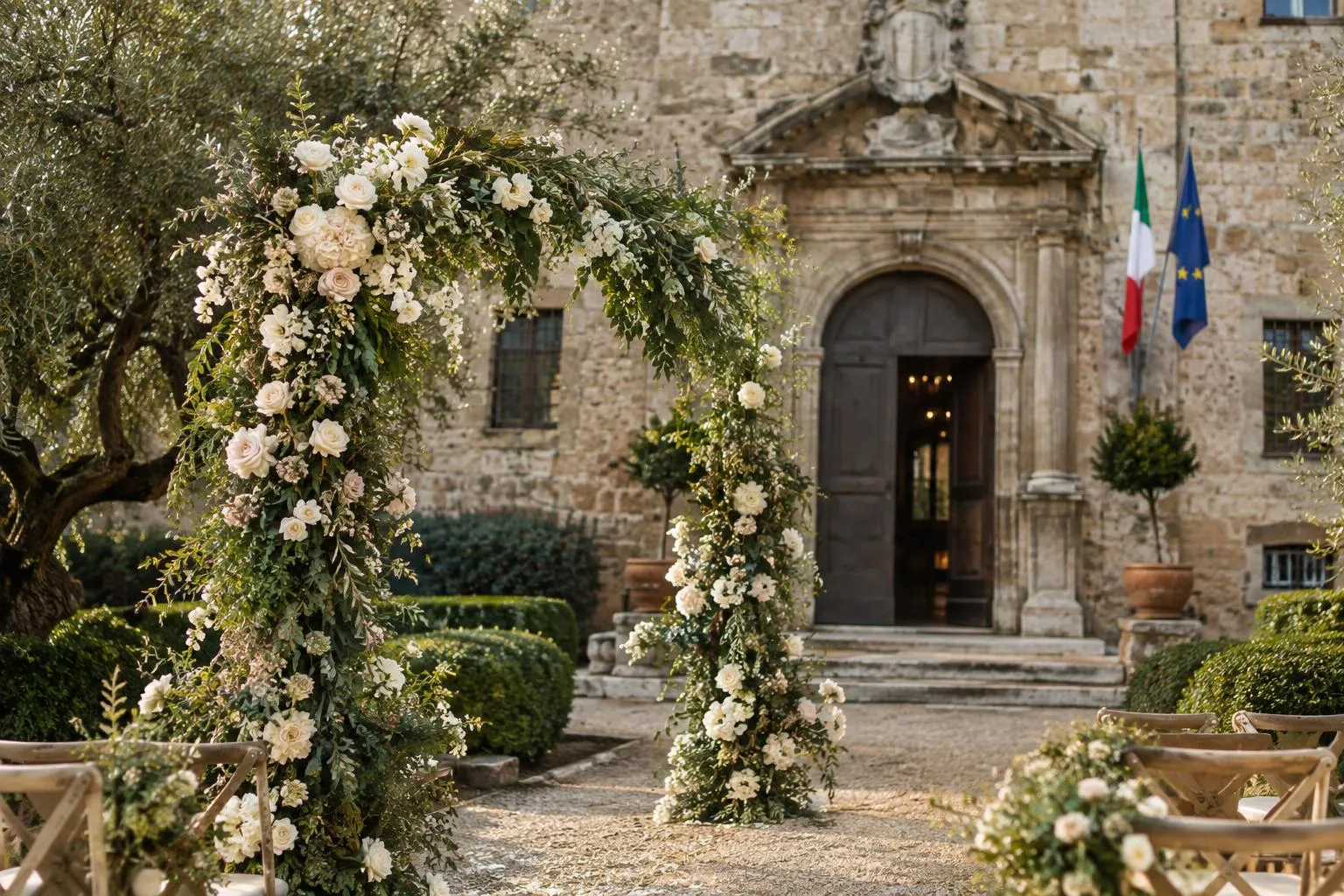
Couples planning a wedding in Tuscany almost always face the same question: do we need a ceremony that is legally binding in Italy, or is a symbolic one enough? These are two different formats with different logic, and they should not be confused. A beautiful ceremony in a villa garden does not, on its own, make a couple married in the eyes of the law. This guide compares the two options on clear criteria: legal force, freedom of venue, documents, language and script. It also shows how couples combine them and which questions to ask yourselves early. Requirements depend on citizenship, so the final conditions are always confirmed with the comune and the consulate.
What a symbolic ceremony is
A symbolic ceremony has no legal force: it does not register a marriage and does not change your civil status. Its great advantage is freedom. You choose the place together with the owner of the venue: a villa garden, an olive grove, a terrace over the hills, or a beach, provided the rules of the place allow it. The script is just as free. It is written for the couple: the words of a host or celebrant, vows in several languages, rituals with candles, wine or sand, music, a role for children and parents. No official is needed and documents are generally not required for the ceremony itself, so preparation is simpler and shorter than for a civil wedding.
What a civil ceremony is
A civil ceremony creates a marriage with legal force. It is performed by the civil registrar, either in a hall of the comune or in a venue the comune has approved for civil weddings. Each comune keeps its own list of approved venues and its own conditions, so the choice is wider than a town hall but narrower than for a symbolic ceremony. The documents you need depend on the citizenship of both partners and are confirmed with the comune and the consulate. Witnesses are normally required, and if you do not speak Italian, so is an interpreter. The wording of the ceremony is set by law, so there is less freedom in the script: you can add your own words, but the mandatory formulas stay.
The main differences, point by point
Legal force: a civil ceremony has it, a symbolic one does not. Place: a symbolic ceremony can be held wherever the owner agrees, while a civil one takes place in a comune hall or a venue the comune has approved. Documents: for a civil wedding they are collected and checked in advance, for a symbolic one they are generally not needed. There are less obvious differences too. The time of a civil ceremony is agreed with the registrar's calendar, while a symbolic one can be set at sunset. Language: a civil ceremony runs in Italian with interpreting, a symbolic one in whatever language your guests speak. Timing of preparation: a civil wedding depends on how the comune works, a symbolic one only on the venue and the team being ready.
How couples combine the two formats
The most common arrangement: the couple marries at home or in their own country, and holds a symbolic ceremony in Tuscany for their guests. There are no Italian documents to collect, and the celebration still feels like a real wedding, with vows, music and family around you. A second arrangement is a civil ceremony in Italy with only a few people, for example the day before or in the morning, followed by a symbolic ceremony in a villa with all the guests. A third is a civil ceremony in a comune hall followed straight away by a celebration at a restaurant or villa nearby. Before choosing, ask the consulate or a lawyer how a marriage concluded in Italy is recognised in your country.
Questions that help you decide
Do you need your legal status to come from an Italian ceremony, or is the marriage already registered, or about to be registered, at home? How many guests will attend, and how comfortable are they with a formal part? If the ceremony matters most as a scene at sunset, outdoors, in a place you love, a symbolic format gives you more freedom. Think about timing too. Collecting documents, translations, the application to the comune and agreeing a date all take time, and no exact time frame can be promised because every comune has its own procedure. If your date is fixed and your documents are not ready, a symbolic ceremony is the safer base, with the civil part decided separately.
Typical mistakes
The first mistake is to assume a symbolic ceremony is legally binding and to find out only after the celebration. The second is to leave documents until the last moment and then discover that one of them needs legalisation or translation. The third is to plan the hour of a civil ceremony without confirming it with the comune, and to build the whole day's schedule around it. Another is to expect that any garden can host a civil ceremony: the comune has to approve the venue. And finally, couples forget to check how an Italian marriage will be recognised at home, and raise the question when invitations are already out. Check this with your consulate before paying for a venue.
What to decide before choosing a format
- Whether you need a legal marriage in Italy or will register it at home
- The citizenship of both partners and the document list from the comune and consulate
- Whether you need an interpreter for the civil ceremony
- The preferred place: comune hall, approved venue or private villa
- Witnesses and their documents
- The script of the symbolic part: host, vows, rituals
- How an Italian marriage is recognised in your country of residence
- A backup date and a rain plan for an outdoor ceremony
We help you choose a format and shape the ceremony
Tell us where you would like to marry and how many guests to expect. We will suggest how to combine the civil and symbolic parts, and prepare a written estimate on request.