 Tvoi Event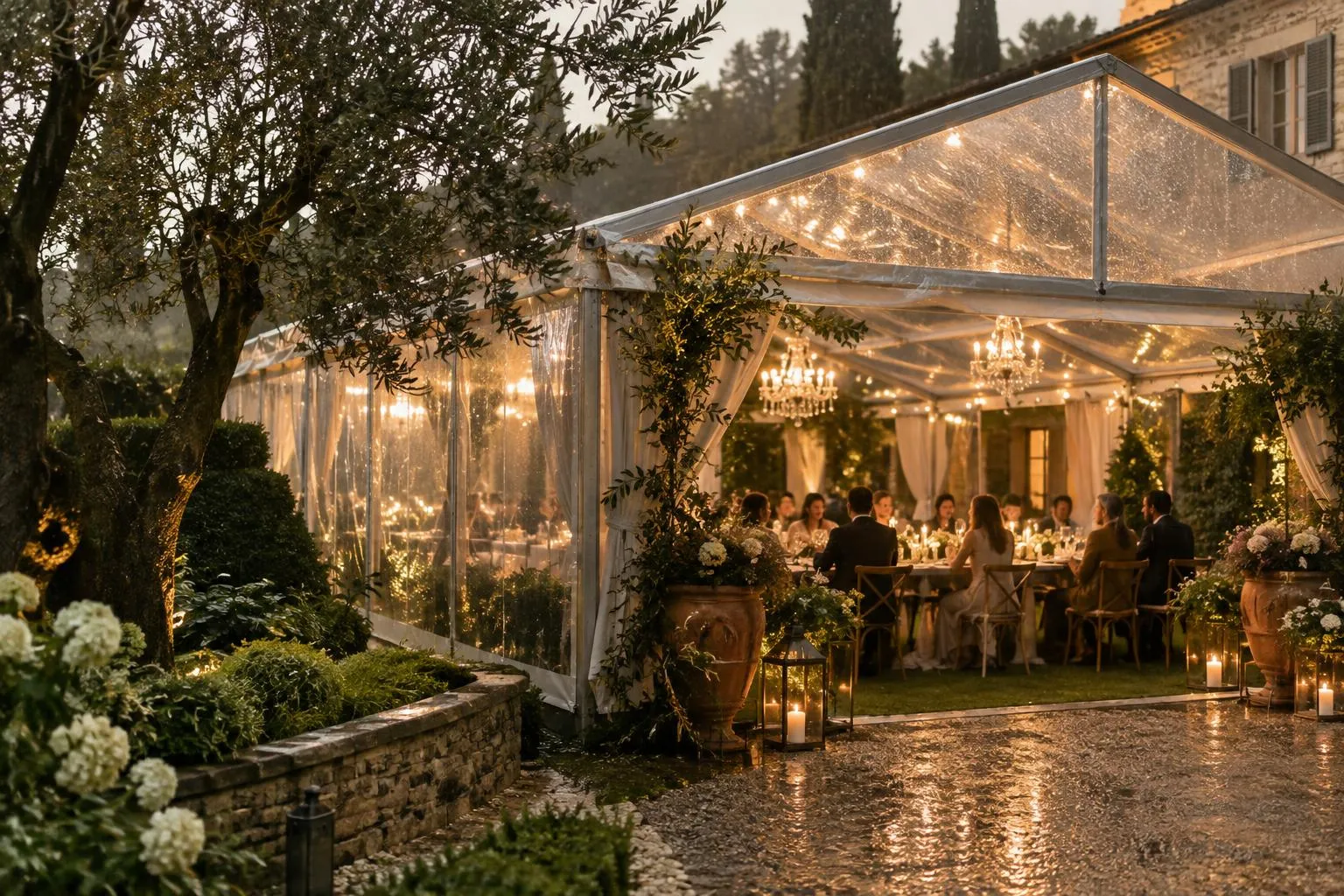
A celebration in a villa garden or a vineyard is lovely because it takes place outdoors. But the weather in Tuscany is changeable in spring and autumn, and summer can bring short, heavy storms. Nobody can promise sunshine for a given day, yet you can decide in advance what you will do if it does not come. A plan B is not pessimism, it is part of the script. Once the backup is written down, priced or at least agreed, rain becomes an organisational task. Without one it becomes stress for everyone from the couple to the waiters and florists. This guide covers the options, the decision deadline and how to brief guests and vendors.
Why a backup is needed
Rain is not dangerous in itself; the trouble is that decisions have to be made at the last minute. Chairs must be moved, the ceremony shifted, guests accommodated indoors, the photographer, the musicians and the kitchen told. If the backup has not been thought through, one of those links will fail. That is why plan B should be discussed when you choose the venue, not a week before the event. Ask the owners whether there is a covered hall, how many people it holds, whether a tent can be put up and who is responsible for it. If the villa offers nothing suitable, that is a reason to rethink the venue, not to hope for good weather.
Three main options
The first option is an indoor space at the venue itself: a conservatory, a loggia or a hall. It is the simplest route, provided the room holds every guest and suits the mood. The second is a tent or marquee on the outdoor site. It keeps the feeling of an open-air party but needs a separate order, time to build and the permission of the owners. The third is a flexible sequence. The ceremony and aperitivo take place under cover or in a gallery and the dinner moves into the hall, or the other way round. Often it is enough to move one element to save the evening. Which option to choose depends on the number of guests, the space, the season and the way the property is laid out, so there is no universal answer.
Tent: what to check
If you choose a tent, ask what type it is and whether it can handle wind: a light canopy is not a substitute for a solid marquee with a frame. Check the floor, because grass and bare ground turn slippery and damp after rain, so a base or flooring is needed. Ask how the tent is lit and heated if the event falls in spring or autumn, when evenings are cool. Installation is a separate question. A tent needs time to go up, and the supplier must know when to arrive. If the decision to build is made one day ahead, you need to know whether the crew can manage it. Also check that the owner allows such structures on the grounds, and whether there are limits in protected gardens or historic courtyards.
Indoor hall: adapting the script
Moving inside changes the layout: the ceremony, the dinner and the dancing share one space instead of occupying separate zones. Plan a seating chart for the indoor room in advance, with places for the musicians, the bar and the photographer. The capacity of an indoor hall may be lower than that of the outdoor site, and you need to know that before the guest list is confirmed. Flowers, decor and lighting are worth preparing in two versions. Arrangements for an outdoor arch and aisle differ from room styling, and candles and hanging lights behave differently indoors. Agree with the florist and the decorator that they will receive the signal about the chosen option in time and can switch quickly.
The decision deadline
The most important point of a plan B is who decides and when. Appoint one person, usually the coordinator, and set the hour by which the choice has to be made. That hour is agreed with the most dependent vendors: the tent supplier, the florist, the caterer and anyone who needs to move equipment. How much time each of them needs is best found out in advance. Treat weather forecasts with caution: several days ahead they still change, one day ahead they are more reliable. A good approach has two steps, a provisional decision a few days before and a final one at the agreed hour. The arrangement goes into the schedule of the day, so nobody argues in the morning and every team knows what to expect.
Telling guests and vendors
Guests should not have to guess what is happening. The invitation can mention that part of the programme may move indoors and suggest shoes that are comfortable on grass and a light wrap or umbrella. On the day, the person in charge sends a short message with the chosen option, place and time. Vendors need the information earlier and in more detail: the room plan, the set-up time, the route for equipment. The photographer must know where the light is, the musicians where to connect, the kitchen how service changes. The most common failure is that the decision is made but nobody has passed it on. The coordinator should hold a contact list with roles well before the day.
Rain plan checklist
- Find out whether the venue has a covered hall and its capacity
- Ask whether a tent is allowed and who builds it
- Check floor, lighting and heating of the backup option
- Prepare a seating plan for both versions
- Name one decision-maker and a deadline
- Brief the florist, musicians, photographer and kitchen
- Mention a possible move indoors in the invitation
A backup written into the script
Tvoi Event writes a plan B for every outdoor celebration: we identify the backup hall or tent, agree the decision deadline and brief the vendors. Send a request and we will prepare a written estimate.